
How to Hold Your Breath Longer for Freediving
Learning how to hold your breath longer is one of the most common goals for beginner freedivers. Many people believe that breath-hold performance depends mainly on lung capacity or natural talent, but the reality is very different.
Most freedivers improve their breath-hold by learning how to relax, breathe efficiently and develop greater tolerance to carbon dioxide. With proper training, many students can significantly improve their performance without forcing themselves or taking unnecessary risks.
Whether you are preparing for your first freediving course, improving your snorkelling experience or training for better underwater performance, understanding the fundamentals of breath-hold training is essential.
At Apnea Fuerteventura, we teach safe and progressive freediving techniques in South Fuerteventura, helping students build confidence both in the pool and in the ocean.
Why Do We Feel the Urge to Breathe?
One of the biggest misconceptions about freediving is that the urge to breathe comes from a lack of oxygen.
In reality, the first signals that tell us to breathe are mainly caused by rising carbon dioxide (CO₂) levels in the body.
As your breath-hold continues, oxygen levels slowly decrease while carbon dioxide levels increase. The brain responds by sending stronger signals that create the sensation of needing to breathe.
These sensations may include chest pressure, diaphragm contractions, mental discomfort and increasing awareness of your breathing.
Understanding this process is one of the first steps towards becoming a more relaxed and efficient freediver.
The Biggest Beginner Mistake: Hyperventilation
Many beginners believe that taking multiple deep breaths before a breath-hold will increase their performance.
This is one of the most dangerous mistakes in freediving.
Hyperventilation artificially lowers carbon dioxide levels and delays the body’s natural warning signals. Although it may make a breath-hold feel easier initially, it can significantly increase the risk of blackout.
Safe freediving breathing should always feel calm, controlled and relaxed.
The objective is not to trick the body but to prepare it properly for the dive ahead.
Professional freedivers rely on relaxation and technique rather than excessive breathing.
👉 Discover how proper Breathwork Training can help improve relaxation and performance.
Safety First: Never Train Breath-Hold Alone
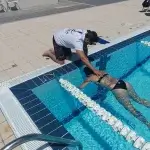
Before discussing training methods, safety must always come first.
Breath-hold training should never be practised alone in water. This includes swimming pools, the ocean and any environment where a loss of consciousness could become dangerous.
If you are training dry apnea at home, choose a safe position such as sitting or lying down and stop immediately if you feel unwell.
At Apnea Fuerteventura, all water training is supervised and follows recognised freediving safety standards.
Safety is not optional. It is the foundation of every successful freediver.
👉 Safety procedures are taught in every Try Freediving Experience and PADI Freediver Course.
Step 1: Learn to Relax Before Every Breath-Hold
Relaxation is the single most important skill in freediving.
Many beginners waste oxygen before the breath-hold even begins because they are nervous, excited or physically tense.
Tension in the face, jaw, shoulders, hands and legs increases oxygen consumption and reduces performance.
By learning how to relax before every breath-hold, you allow the body to work more efficiently and conserve energy.
A calm mind and a relaxed body will always outperform a tense athlete underwater.
Simple Relaxation Routine
Before every breath-hold:
- Relax your facial muscles.
- Release tension from your shoulders.
- Slow down your breathing.
- Focus on calmness rather than performance.
- Stay mentally relaxed.
A relaxed body consumes less oxygen and remains comfortable for longer.
Example Breathing Pattern
A simple preparation routine may include:
- Inhale gently for 3 seconds.
- Exhale slowly for 6 seconds.
- Repeat for several minutes.
This type of breathing helps promote relaxation and prepares the body for efficient breath-hold performance.
Step 3: Focus on CO₂ Tolerance
One of the fastest ways to improve breath-hold performance is to develop greater tolerance to carbon dioxide.
As CO₂ levels rise, discomfort increases. Training helps you remain calm and comfortable despite these sensations.
This is where CO₂ tables become extremely valuable.
CO₂ training allows freedivers to become more comfortable with rising carbon dioxide levels and develop stronger mental control.
Benefits of CO₂ Training
CO₂ tables can help:
- Improve breath-hold comfort.
- Increase relaxation.
- Develop mental resilience.
- Reduce anxiety during apnea.
- Improve confidence underwater.
Many beginner freedivers notice significant improvements after only a few weeks of structured CO₂ training.
Step 4: Train Static Apnea
Static apnea is one of the most effective forms of freediving training.
Unlike dynamic apnea or depth training, static apnea removes movement and allows complete focus on relaxation.
This makes it an ideal training method for beginners who want to understand how their body responds during a breath-hold.
Static apnea improves awareness, relaxation and breath-hold efficiency while building confidence in a controlled environment.
Benefits of Static Apnea Training
Static apnea helps improve:
- Relaxation.
- CO₂ tolerance.
- Mental control.
- Breath-hold awareness.
- Recovery breathing habits.
- Overall confidence.
Step 5: Improve Recovery Breathing
Recovery breathing is an essential freediving safety skill.
After every breath-hold, the body benefits from a controlled recovery process that helps restore normal breathing patterns and stabilise oxygen levels.
Learning proper recovery breathing should become a habit from the very beginning of your freediving journey.
Basic Recovery Breathing Sequence
- Take a controlled inhale.
- Perform a short active exhale.
- Repeat several times.
- Remain calm and relaxed.
- Avoid speaking immediately after a strong breath-hold.
Step 6: Move Efficiently in the Water
Many freedivers lose valuable oxygen through inefficient movement.
Excessive kicking, poor body position and unnecessary tension all increase oxygen consumption.
Efficient movement allows you to stay underwater longer while using less energy.
Good technique often creates greater improvements than simply trying harder.
Step 7: Build Confidence Through Regular Training
Consistency is more important than intensity.
Many beginners focus exclusively on achieving personal records, but sustainable progress comes from regular and structured practice.
A combination of static apnea, CO₂ training, breathwork and supervised water sessions produces the best long-term results.
Freediving is a skill that improves gradually over time.
The Role of Breathwork in Freediving
Breathwork has become increasingly popular among freedivers, surfers and athletes.
Proper breathwork can improve relaxation, body awareness and breathing efficiency while helping reduce stress levels before training.
Although breathwork alone will not transform your breath-hold overnight, it can significantly improve the quality of your training sessions.
How Long Should Beginners Hold Their Breath?
There is no perfect breath-hold time for beginners.
Some people start with 30 seconds while others quickly reach one or two minutes after learning basic relaxation techniques.
The most important objective is not chasing numbers but developing control, safety and consistency.
Longer breath-holds naturally follow when the foundations are built correctly.
Common Mistakes That Limit Progress
Many people struggle to improve because they make avoidable mistakes.
Common examples include:
- Hyperventilation.
- Training alone.
- Poor relaxation.
- Forcing breath-holds.
- Ignoring recovery breathing.
- Comparing themselves to others.
- Focusing only on time rather than technique.
Freediving rewards patience and consistency.
Training in South Fuerteventura
South Fuerteventura offers excellent conditions for freediving training.
With calm water, warm temperatures and beautiful ocean environments, it provides an ideal setting for both beginners and experienced freedivers.
At Apnea Fuerteventura, we offer structured training programmes including Try Freediving Experiences, PADI Freediver courses, breathwork sessions, static apnea training, dynamic apnea training and ocean confidence coaching.
Training takes place near Costa Calma, La Lajita, Las Playitas, Jandía and Morro Jable.
Ready to Improve Your Breath-Hold?
Explore our Freediving Courses, Try Freediving Experiences, CO₂ Training Tables and Breathwork Programmes to continue your progression safely and confidently.
Whether your goal is relaxation, performance or ocean confidence, Apnea Fuerteventura can help you develop the skills needed to become a safer and more capable freediver.
